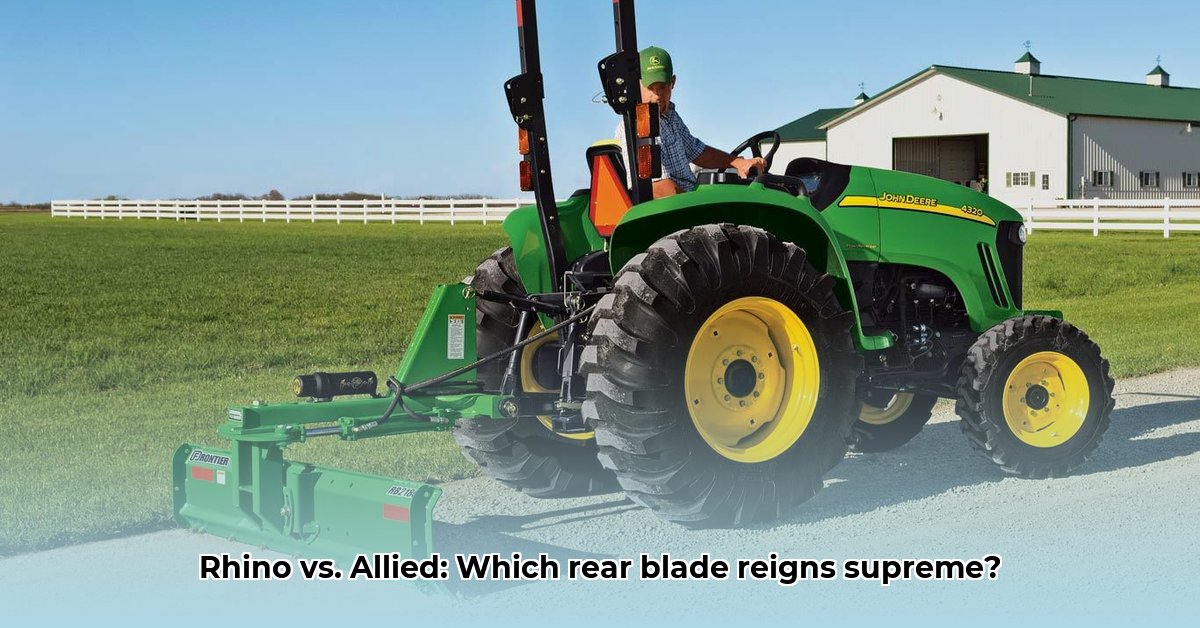
Choosing the right rear tractor blade is crucial for efficient and effective farm work. This detailed comparison review helps you decide between two leading brands: Rhino and Allied by Farm King. We'll examine key features, highlighting their strengths and weaknesses to guide your decision. For more information on choosing the right blade, see this helpful guide.
Criteria for Comparison
We'll evaluate these blades based on:
- Horsepower Compatibility: The blade's weight and capacity must match your tractor's power.
- Hydraulic Adjustments: Features like hydraulic tilt, swivel, and offset enhance precision. Manual adjustments are simpler but less precise.
- Offset Capability: The ability to shift the blade sideways for working near obstacles.
- Durability: Construction materials and overall build quality impact lifespan.
- Cost: Initial investment and potential maintenance costs.
- Maintenance: Ease of maintenance and repair.
Rhino Blade Review
Rhino blades are renowned for their robust construction and ability to handle demanding tasks. Their durable steel build ensures longevity, but this comes with a heavier weight, requiring a more powerful tractor. Larger models (2500 and 3500 series) offer full hydraulic adjustments for precise control and a significant offset capability (up to 50 inches on the largest model), allowing for close work to obstacles. While exceptionally durable, this robust build might necessitate more frequent maintenance compared to lighter options.
Pros:
- Exceptional Durability: Built for years of heavy use.
- Significant Offset Capability: Allows for precise work near obstacles.
- High Horsepower Compatibility: Handles demanding tasks with powerful tractors.
- Precise Moldboard Design: Optimized for efficient and clean cutting.
Cons:
- Higher Initial Cost: Represents a significant investment.
- Potentially More Complex Maintenance: The heavier build may require more frequent attention.
Allied by Farm King Blade Review
Allied by Farm King blades offer a cost-effective and versatile alternative. Generally lighter than Rhino blades, they're suitable for a wider range of tractor sizes and power outputs. They offer varying levels of hydraulic adjustment depending on the model, and while the offset capability is present, it's typically less extensive than the Rhino's. Allied blades are often praised for their ease of maintenance and repair, resulting in lower long-term costs.
Pros:
- Wide Horsepower Compatibility: Works with various tractor sizes.
- Competitive Pricing: A more budget-friendly option.
- Simpler Maintenance: Often easier to maintain and repair.
Cons:
- Less Extensive Offset: Limited ability to work close to obstacles compared to the Rhino.
- Limited Hydraulic Adjustment on Some Models: Some models rely on manual adjustments.
- Standard Moldboard Design: While functional, not as refined as the Rhino’s design.
Head-to-Head Comparison
| Feature | Rhino Blade | Allied Farm King Blade | Implications |
|---|---|---|---|
| Typical Weight | Heavier | Lighter | Affects tractor HP requirements; heavier blades are better for heavy-duty tasks. |
| Hydraulics | Often fully hydraulic (tilt, swivel, offset) | Varies by model; may be manual or partially hydraulic | Hydraulic systems offer more precision; manual adjustments are simpler and cheaper. |
| Offset | Typically significant offset | Varies by model; generally less than Rhino | Important for working close to obstacles. |
| Durability | Generally high | Good; often sufficient for many applications | Impacts lifespan and maintenance needs. |
| Cost | Typically higher | Generally lower | Consider your budget and anticipated workload. |
| Maintenance | May require more frequent maintenance | Often easier to maintain | Affects long-term running costs. |
Buying Guide/Recommendations
The best blade for you depends on your specific needs:
Heavy-Duty Applications (Land Clearing, Snow Removal): A Rhino blade with full hydraulics is recommended for its strength and precision. Is this significant offset capability truly necessary for your work? Consider this carefully.
Smaller Tractors & Lighter Work (Landscaping, Light Grading): An Allied blade offers good value, particularly if budget is a concern. Look for a model with some hydraulic adjustments for improved control. A rhetorical question: Would the added precision offered by hydraulics be worth the higher cost?
Budget-Conscious Users: An Allied blade is a cost-effective solution, offering suitable performance for many applications. This is especially true if your work doesn't require extensive offset.
Always verify compatibility with your tractor's specifications. Consider gauge wheels for improved grading consistency regardless of brand.
Frequently Asked Questions (FAQ)
Q: What's the difference between PTO and gross engine horsepower? A: PTO (power take-off) horsepower is the power available at the tractor's PTO shaft, relevant for rear blade operation. Gross engine horsepower is the engine's total power output; PTO horsepower is lower.
Q: Are gauge wheels necessary? A: Gauge wheels are beneficial for consistent grading depth but aren't crucial for all applications.
Q: How do I determine the right size blade for my tractor? A: Consult your tractor's owner's manual for recommended blade weight and horsepower compatibility. Overloading your tractor can lead to damage.
This comparison provides a foundation for your decision. Remember to consider your budget, the types of tasks you’ll perform, and your tractor’s capabilities to ensure you choose the most suitable rear tractor blade.